


Investors now expect artificial intelligence (AI) to come up in most SEC filings. Talk of artificial general intelligence (AGI), the next step beyond AI, is starting to show up, too.
The Motley Fool's AGI Disclosure Index found 29 companies using AGI-related language in SEC filings since January 2023. Of those, 21 started after June 2025. By comparison, 437 of 515 S&P 500 and Nasdaq-100 companies cited AI in annual reports filed in 2026.
AI is software that handles defined tasks. AGI doesn't have a widely agreed-upon definition and is generally viewed as a threshold. OpenAI's 2018 charter defines it as "highly autonomous systems that outperform humans at most economically valuable work." Superintelligence arguably goes further. Meta's 2026 10-K defines it as AI that surpasses human intelligence.
Asit Sharma, senior investment analyst and lead advisor at The Motley Fool, finds it telling that the definition of AGI is up for debate. "It's intriguing that frontier model builders, technology companies, and the public haven't yet been able to agree on a standardized definition of AGI," he said. "To us, this underscores the magnitude of its potential impact."
Story continues below Trending Shorts
Executives are already talking about the shift from AI to AGI, but they disagree on timing. Meta Platforms CEO Mark Zuckerberg said in a July 2025 earnings release filed with the SEC, "I'm excited to build personal superintelligence for everyone in the world." Nvidia CEO Jensen Huang wrote on X on Sept. 6, 2026, "AGI has arrived." He posted after OpenAI released its GPT-6 Astra model. Alphabet CEO Sundar Pichai said in June 2025 on the Lex Friedman Podcast that AGI is possible shortly after 2030.
Key findings
- AGI vs. AI: 437 of 515 S&P 500 and Nasdaq-100 companies cited AI in 2026 annual reports, but only Meta used AGI-related language.
- Twenty-one of the 29 companies using AGI language in SEC filings since 2023 started after June 2025.
- Companies describe AGI as an opportunity more than twice as often as a risk: 14 companies compared with six.
There's a difference between what a CEO says and what a company tells investors in a filing. Interviews and social posts show where an executive thinks the tech is headed. SEC filings show how a company weighs risk and opportunity. They also show where it puts its money and contracts, and how it plans its strategy. Those filings include annual reports (10-K), quarterly reports (10-Q), and press releases filed on an 8-K, the form companies use to announce news.
The Motley Fool built its AGI Disclosure Index to track when, where, and how companies use AGI-related language. That means five terms: "artificial general intelligence," "AGI," "superintelligence," "superintelligent," and "artificial superintelligence." It counts them only when companies discuss their own risks, products, strategy, spending, investments, or contracts. It covers SEC filings from January 2023 through Oct. 14, 2026.
For investors, these early mentions are a first look at how companies are formally planning for AGI.
AGI language is beginning to appear in SEC filings
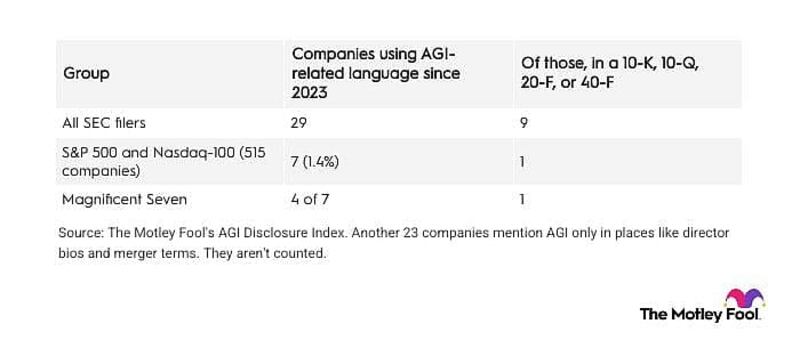
The Motley Fool's AGI Disclosure Index found 29 companies of all sizes using AGI language in an SEC filing since 2023. Seven are in the S&P 500 or Nasdaq-100. Four of those seven are Magnificent Seven stocks (Apple, Microsoft, Alphabet, Amazon, Nvidia, Meta, and Tesla).
The Motley Fool
AI language is far more common. Among the 515 S&P 500 and Nasdaq-100 companies, the share citing AI in annual reports rose from 36% in 2023 to 85% in 2025. Only one company, Meta, has used AGI language in an annual report, in January 2026. Every company files an annual report each year, so it's the cleanest year-to-year comparison.
Technology companies lead. Information technology companies make up about 16% of the 515 companies, yet they account for four of the seven that have used AGI language. Meta and SpaceX are communication services companies, and Amazon is in the consumer discretionary sector. None of the companies in the other eight stock market sectors used AGI language in the filings searched.

The Motley Fool
AI language took about two years to become standard in most annual reports. It's too soon to tell whether AGI will follow the same path.
AGI mentions in SEC filings are accelerating, from 2 companies in a quarter to 11 in a year
For most of the past three years, AGI language was rare in SEC filings. Mentions picked up in the second half of 2025 and have sped up since, according to The Motley Fool's AGI Disclosure Index.
- Companies using AGI language rose from two in the second quarter of 2025 to 11 a year later, according to the AGI Disclosure Index. Four companies used it in the third quarter of 2025, seven in the fourth, and eight in the first quarter of 2026.
- The AGI Disclosure Index found that 21 of the 29 companies first used AGI language after June 2025. The other eight started between January 2023 and June 2025.
- All seven S&P 500 and Nasdaq-100 companies using AGI language started after June 2025, according to the AGI Disclosure Index. Meta was first, in a July 30, 2025, earnings release filed with the SEC. Nvidia was the latest, in an August 2026 press release filed with the SEC.
Companies describe AGI as an opportunity more than twice as often as a risk
The Motley Fool's AGI Disclosure Index found that 14 of the 29 companies describe AGI in the context of strategy or opportunity in at least one filing. Six describe it as a risk.
- Meta is the only company that describes AGI as both an opportunity and a risk, according to the AGI Disclosure Index. The other five that call it a risk, all in risk-factor sections, are outside the S&P 500 and Nasdaq-100.
- Only nine of the 29 companies used AGI language in an annual or quarterly report, the AGI Disclosure Index found. The other 20 used it only in 8-K press releases or offering documents. Fourteen first used it in an 8-K, and nine first used it in an IPO or other offering document.
- Only Meta ties AGI language to spending, and only Microsoft ties it to contract rights, according to the AGI Disclosure Index. Meta's 10-K and 10-Qs discuss superintelligence in a spending note and as a risk factor. Microsoft's October 2025 filing with the SEC states that its rights to OpenAI's models run through 2032. Those rights cover models built after AGI is achieved.
Once AGI language spreads into 10-Ks and 10-Qs, those filings could tell investors a lot more. They could show how much each company spends on AGI and how it weighs the risks. They could also show how each company plans to profit and where AGI fits in its strategy.
Meilin Quinn, Hidden Gems analyst at The Motley Fool, is watching for AGI to show up in the risk sections of non-tech companies. For now, she said, the few mentions mostly come from tech companies describing their ambitions. "Companies have to disclose once new tech threatens their customers or pricing power," Quinn said. She pointed to the 2025 annual report from JPMorgan Chase. It already warns that AI agents could take on more of customers' financial decisions.
"The day a business replaces its warnings about AI agents with warnings about AGI is the day it effectively admits that AI has evolved beyond today's narrow tasks into most of the work its employees and products do," Quinn said. "Investors would then be on the clock to sort which companies can adapt to AGI vs. which AGI replaces. I'd rather start sorting those out now."
Sharma expects one breakthrough to set off that shift. He said an "iPhone moment" or "ChatGPT moment" for AGI will likely settle the debate over what AGI means. "When that happens, we expect to see a surge in risk-related disclosures within SEC filings, as businesses first grapple with potential disruption impacts," he said.
He also expects early signs in the section of annual and quarterly reports where managers explain their results. It's called "management's discussion and analysis (MD&A)." There, managers could credit AGI for big swings in the cash tied up in daily operations or more spending on buildings and equipment. They could also credit it for profits growing faster than sales or shorter research timelines. "In short, we foresee fruitful sleuthing for investors who plan to follow AGI frequency (and closely related terminology) in filings over the next couple of years," Sharma said. "Of course, this depends on when and if the catalyzing 'AGI moment arrives."
7 large companies use AGI-related language, and 4 of them are Magnificent 7 stocks
Microsoft, Amazon, Nvidia, and Meta have each used AGI language in an SEC filing since 2023, according to The Motley Fool's AGI Disclosure Index. Alphabet, Apple, and Tesla, the other Magnificent Seven stocks, haven't. AMD, CrowdStrike, and SpaceX are the other three large companies on the list.

The Motley Fool
- Meta is the only one of the seven to put AGI language in a 10-K or 10-Q, according to The Motley Fool's AGI Disclosure Index. The company's January 2026 10-K says it's hard to predict when superintelligence may arrive, and that Meta is investing now.
- Nvidia's CEO says AGI has arrived, but none of Nvidia's 15 annual and quarterly reports since 2023 mention it, the AGI Disclosure Index found. Huang made the claim in a September 2026 post on X. Nvidia's only mention of AGI in a filing is a quote from SoftBank's chairman in an August 2026 press release filed with the SEC.
- Three of the seven companies mention AGI through a partner's words, according to the AGI Disclosure Index. Amazon and AMD each filed a press release with OpenAI's standard description of its AGI mission. Nvidia filed one that quotes SoftBank's chairman.
The seven companies span the AI supply chain. Nvidia and AMD make chips, Microsoft and Amazon run cloud computing, Meta builds AI models and products, and CrowdStrike works in cybersecurity. SpaceX works on both computing infrastructure and AI models. For investors, that's a rough map of which companies take AGI seriously enough to put it in their own filings.
Why the gap between AGI talk and AGI filings matters for investors
AGI language in SEC filings helps investors cut through the noise of executive interviews and social posts. It shows how companies are putting contracts, capital, and strategy behind the next phase of AI.
AGI could touch nearly every part of the economy, and so nearly every investor's portfolio. That makes it more important to see how companies are actually preparing for it. SEC filings are one place to look.
How companies talk about AGI is more important than how often they do so. The timeline for AGI to be achieved, let alone pay off, is very uncertain. If AGI turns out to be a technology that's always 10 years away, filings would likely look like Meta's do today. They'd show long-term goals and ongoing spending, with a note that timing is hard to predict. If AGI suddenly bursts onto the scene, the language would likely quickly move into risk disclosures, product descriptions, revenue discussions, and contracts.
Methodology: How the AGI Disclosure Index is built
The Motley Fool's AGI Disclosure Index tracks which companies use AGI-related language in SEC filings and how they use it. It searched the SEC's EDGAR system across all filers and sectors from Jan. 1, 2023, through Oct. 14, 2026. That included the filings of at least 515 companies, the S&P 500 and the Nasdaq-100 as of Oct. 1, 2026. Those companies are reported here as a separate group. Companies that sit in both indexes or have two share classes are counted once, and a company counts once no matter how many times it uses the language. Sectors follow GICS for S&P 500 companies, and the 15 Nasdaq-100 companies outside the S&P 500 are matched to the closest GICS sector from Nasdaq's classification. SpaceX is counted in communication services because Nasdaq lists it under telecommunications.
The AGI Disclosure Index includes annual and quarterly reports (10-K, 10-Q, 20-F, and 40-F), current reports (8-K) and their exhibits, offering documents such as IPO prospectuses, and proxy statements. Fund filings are excluded. AGI-related language means "artificial general intelligence," "AGI," "superintelligence," "superintelligent," and "artificial superintelligence." Related phrases such as "human-level AI" were tracked separately and aren't in the figures above. The AI comparison counts companies that used the exact phrase “artificial intelligence” in an annual report, so it's a conservative estimate.
A large language model read 759 unique passages flagged from those documents and labeled how each AGI-related term was used, such as risk, product, strategy, spending, or contract language, and whether it referred to AGI as an idea. Only passages about a company's own risks, products, strategy, revenue, spending, investments, or contracts are counted in the index.
The AGI Disclosure Index excluded passages where an AGI-related term meant something else. These include product names (such as a chip line with AGI in its name), stock tickers, company names, web links, and brand labels a company gives its own AI product without claiming AGI-level capability. Director and officer biographies, merger-agreement definitions, general background text, and board-governance statements are left out of the index because they don't describe a company's own risks, products, revenue, or investments.
The figures describe what companies wrote in filings. They don't measure any company's exposure to AGI and aren't investment advice. Searches match exact words, so companies that describe the same idea in other terms may not be counted.
This story was produced by The Motley Fool and reviewed and distributed by Stacker.