


In rental real estate, “landlord-friendly” is not an official legal category. It is a shorthand investors often use for states where rental housing rules are predictable, rent setting is less restricted, and property owners have clearer pathways to handle lease violations, nonpayment, and turnover.
That does not mean these states are free of regulation. Landlords are still bound by federal fair housing laws, state landlord-tenant statutes, local codes, lease requirements, and court procedures. But for investors comparing markets, state policy can influence how quickly a property can be leased, how easily rent can adjust to market conditions, and how much uncertainty surrounds long-term returns.
To better understand the traits investors often consider when comparing rental markets, Faranesh Real Estate and Property Management, a Nevada property management company, reviewed U.S. housing and population trends alongside publicly available state rental policy information.
Population growth is often the first sign
Many states considered favorable to landlords are also places where more people are moving in than leaving. Rental demand depends not only on legal rules but on whether households are forming, jobs are growing, and newcomers need places to live before they buy.
Story continues below Trending Shorts
Press Release Number: CB24-213 // United States Census Bureau
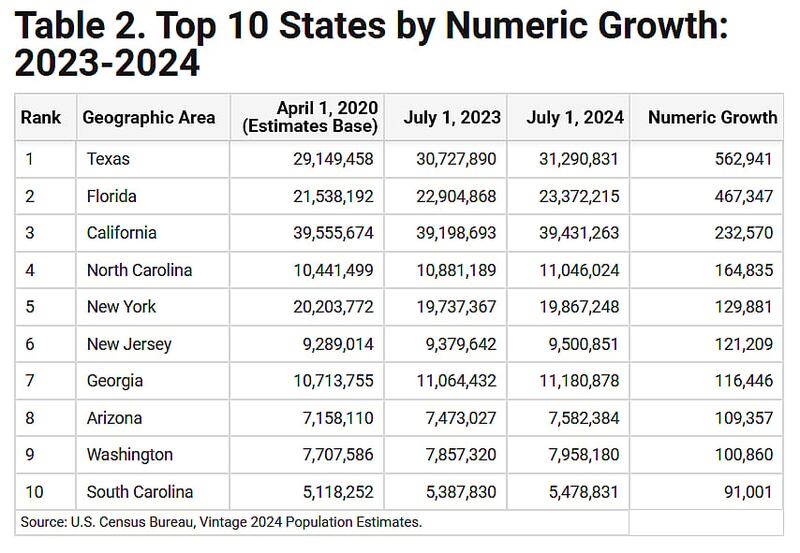
Texas and Florida posted the largest numeric population gains in the country from 2023 to 2024, adding 562,941 and 467,347 residents, respectively, according to the Census Bureau. North Carolina, Georgia, Arizona, and South Carolina also ranked among the top 10 states for numeric growth during that period.

Press Release Number: CB24-213 // United States Census Bureau
The fastest-growing states by percentage also included many markets that frequently appear on investor watchlists. Florida grew 2.0%, Texas 1.8%, South Carolina 1.7%, Nevada 1.7%, Idaho 1.5%, North Carolina 1.5%, and Arizona 1.5% from 2023 to 2024.
For rental owners, that growth can create a larger pool of potential tenants. It can also increase competition for available housing when construction does not keep pace with new demand.
Fewer rent-setting restrictions can create predictability
Another common feature in landlord-friendly states is limited local authority to impose rent controls.
Rent control generally refers to state or local government actions that restrict rent increases or service fees charged to tenants. In markets where rent controls are restricted or preempted, investors may have more confidence that rental income can adjust with taxes, insurance, repairs, and financing costs.
Florida is one example. State law says municipalities, counties, or other local government entities may not adopt or maintain measures that impose controls on rents.
Arizona law also gives landlords and tenants broad latitude to set rental-agreement terms, including rent and lease length, so long as those terms are not prohibited by law.
That does not mean owners can ignore habitability standards, fair housing rules, lease terms, or court procedures. It does mean rent-setting authority is more likely to remain part of the private rental agreement than a city-level price-control system in some of these states.
Lease-enforcement timelines are another investor concern
Investors also pay attention to how states handle rent nonpayment and lease violations. The question is not only whether an owner can remove a tenant for nonpayment, but also how clearly the process is defined.
In Florida, if a tenant fails to pay rent when due and the default continues for three days, excluding Saturdays, Sundays, and legal holidays, after written demand for payment or possession, the landlord may terminate the rental agreement.
Arizona law gives tenants five days after written notice to pay unpaid rent before a landlord may terminate the agreement by filing a special detainer action.
Those timelines are not the whole eviction process. Court schedules, local practices, service rules, tenant defenses, and emergency protections can all affect how long a case takes. But from an investor’s perspective, statutes that specify notice periods can make operating risk easier to evaluate.
Investors are watching the Sun Belt for more than one reason
The connection between investor activity and landlord-friendly markets is especially visible in single-family rentals.
After the 2007-2009 financial crisis, institutional investors bought many foreclosed homes and converted them into rentals, especially in southern states, according to the U.S. Government Accountability Office. GAO found that by June 2022, institutional investors accounted for a large share of the single-family rental market in many cities, particularly in Sun Belt states.
The same report noted that studies have found mixed effects. Institutional investors may have contributed to rising home prices and rents in some markets, but data limitations make it difficult to measure their effects on homeownership opportunities, tenant outcomes, or eviction rates.
Investor attention does not automatically mean a market is healthy for renters, and a state’s legal environment is only one piece of the decision. Investors also evaluate insurance costs, property taxes, construction pipelines, wage growth, vacancy rates, and whether renters can afford the rents being charged.
The Census Bureau's Housing Vacancies and Homeownership program tracks rental and homeowner vacancy rates, which are widely used to evaluate the need for housing programs and to gauge the current economic climate. Low vacancies can point to a tight housing supply, while rising vacancies may weaken rent growth or increase concessions.
Affordability pressures are part of the same story
The same conditions that attract investors can create pressure for renters. Fast population growth can increase demand for apartments and single-family rentals. Limited rent regulation can allow prices to move more quickly with the market. Faster enforcement timelines can reduce owner risk but also make housing instability more urgent for tenants who fall behind.
HUD generally defines affordable housing as housing that costs no more than 30% of gross income, including utilities. By that measure, nearly half of renter households with calculable rent burdens were cost-burdened in 2023, according to census data reported by Reuters.
That creates a tension in many fast-growing states. Investors may see strong fundamentals: rising population, growing rental demand, and legal systems that are easier to model. Renters may experience the same trends as higher competition, fewer low-cost options, and greater difficulty saving for homeownership.
What these states have in common
The most landlord-friendly states tend to share several traits rather than a single defining law. They often have growing populations, especially from domestic migration. They tend to leave more rent-setting power to rental agreements. They spell out notice periods and lease-enforcement procedures in state law. They often sit in regions where institutional and smaller investors have already shown interest in single-family rentals, build-to-rent communities, and small multifamily properties.
But the strongest markets are not simply the ones with the fewest tenant protections. A state can be landlord-friendly on paper and still be difficult for owners if insurance premiums rise, property taxes increase, job growth slows, or too many new units hit the market at once. The most durable investor interest tends to appear where legal predictability overlaps with population growth, employment opportunity, and enough housing demand to keep units occupied.
For renters and communities, the policy question is different: whether those markets can add enough housing to accommodate growth without forcing everyday households to spend more of their income on rent. That balance between owner certainty and renter affordability is becoming one of the central housing debates in the states that investors are watching most closely.
This story was produced by Faranesh Real Estate and Property Management and reviewed and distributed by Stacker.