


A pop-up message and disembodied voice coming through her computer startled Jane Isay, then 81. The voice said there was a problem with her bank account and gave her a number to call. Isay, a former book editor who worked and lived independently, did what the message said: She dialed the number on the screen.
The man who answered told her, “Your bank account is about to be scammed. They’re planning to take $35,000 out of your account, so you need to get the money out now.” Isay was instructed to go to her bank and make a withdrawal. “They” would pick it up and preserve it for her. She was warned not to call the bank, which had already been taken over by the “thieves.”
"I think of myself as a pretty smart person," Isay says, in an interview with Knowable Magazine. "I was completely taken in." She even went to two bank branches because the first didn't have enough cash on hand. By the time she arrived at the second, the head teller had been alerted and waved her over. "She asked if my phone was still on, and it was, because the guy had said to leave it on so he could direct me," Isay recalls. The teller wrote a note: "You're being scammed, don't say anything. We've called the police."
Isay was the third person that day involved in this scam, including one woman who lost her life savings, the teller later told her.
Story continues below Trending Shorts
“I felt so stupid,” Isay says.
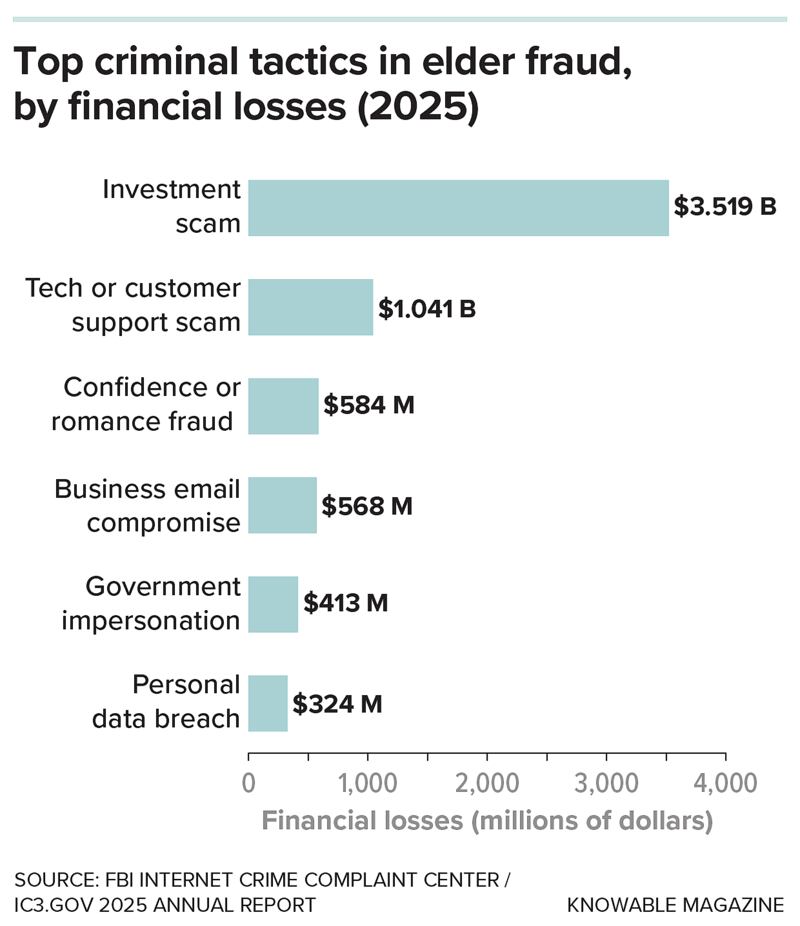
Financial exploitation is estimated to harm between 5% and 17% of people over 60. Data from the FBI's Internet Crime Complaint Center and the Federal Trade Commission show that financial crimes targeting older adults surged from about $600 million in 2020 to between $2.4 billion and $5 billion in 2024. Fraud continued to climb in 2025: Losses reported to the FBI added up to nearly $7.75 billion, while a new report from the FTC estimates that older adults lost up to $119.5 billion that year alone.
And all these numbers may be underestimates, as the crimes are vastly underreported, particularly if the fraud is committed by a family member.
When older victims are successfully scammed, they tend to lose more than younger people do — in a subset of cases, enough to wipe out an entire nest egg, with no working years left to rebuild it.

Knowable Magazine
Is there something about older people — biological, psychological or social factors — that makes them prone to specific types of fraud? In some cases, the answer may be yes. A combination of risk factors contributes to this vulnerability, says Duke Han, a University of Southern California researcher in clinical neuropsychology, gerontology, cognitive aging and financial decision-making. For one thing, he says, older people may have "very subtle changes in brain regions that are involved in being able to imagine certain outcomes, or to assess the correct value of things."
“If there’s even just the subtle decline of those,” he says, “then that could actually make someone more vulnerable to a scammer or fraud.”
Targeted techniques
Older adults aren't necessarily targeted more often than other age groups, but they are targeted differently, says Peter Lichtenberg, a Wayne State University researcher who has tracked federal fraud data for years. That jibes with data suggesting that specific persuasion tactics work better with older targets. According to laboratory tests by Natalie Ebner, a University of Florida expert in cognitive aging, "weapons of influence" such as liking (finding common ground) and reciprocity (offering something free first) are more effective on older adults than on younger ones in laboratory tests.
In the context of an email fraud, for example, scammers may make the victim believe they have something in common, such as being pet owners. Or they may use reciprocation in the form of a low-stakes “gift” (a downloadable brochure, say) to persuade a user to click on a link or reply to an email — which could lead to installation of malware or a virus on the user’s computer.
There are other weapons of influence that scammers might turn to as well. The principle of scarcity might be leveraged through a unique investment offer or creation of a false sense of potential financial security. Emails from phony government agencies might leverage authority to prompt recipients to click on malicious links or provide personal information. Fraudsters may encourage targets to move money into "safe" accounts, guarantee high returns from investments, or convince marks that sending money will protect a loved one from harm.
Fraud vulnerability may rise with diminishment of a brain region called the anterior insula, which connects with other parts of the brain to process information around us and integrate it with what we already know, abilities that are crucial for assessing risk and performing risk-avoidant behavior, Ebner says. Structural and functional changes in that region and how it communicates with other parts of the brain can start in late middle age, she adds.
Older people are also more likely to hold onto familiar information even after being shown it's false, Ebner says. This bias can make a scam feel more credible the more times it's repeated. Counterintuitively, being in a good mood can raise risk too, since positive feelings can lead someone to process incoming information less critically. Research has shown that older people tend to focus more on positive stimuli than younger people do.
“You’re potentially processing the information less intensively because you’re feeling great about everything. So you’re not looking at it as closely. And that could become a risk factor included in aging,” Ebner says.

Knowable Magazine
Older adults are also more likely to have trouble deciding whom to trust a second time. In a 2025 lab study involving games, older adults were, on average, just as likely to re-engage with someone who'd proved ungenerous in a previous round of a game; younger adults learned to avoid such people. Brain scans pointed to a few possible mechanisms behind this difference: less activity in the hippocampus and amygdala while learning how someone had behaved, and less activity in the inferior frontal gyrus, a region responsible for suppressing irrelevant information, that may have left older subjects more swayed by how trustworthy a face appeared, regardless of how someone actually behaved.
Han has also used brain imaging to look for connections between specific brain regions that might explain why some older adults, but not others, become victims. These regions have been previously implicated in risk aversion, scam susceptibility, trust and decision-making when uncertain.
In a study published in 2020, his team conducted MRI brain scans of 16 community-dwelling volunteers 50 and older who had been scam victims and compared the results with 16 matched controls who had not fallen for scams. Overall, the study reported some differences in connections that the hippocampus, insula and medial frontal cortex made with other parts of the brain in the scammed group; these three regions are involved in decision-making and managing social situations. But while some study participants showed clear brain changes, others who were scammed showed no changes at all.
Work with the group continues: "We have a lot of people in our study that are absolutely cognitively intact," Han says. "They are doctors, they are lawyers, they are leaders in their professions and communities." There may be other reasons some cognitively intact participants fell for scams, Han notes, such as greater social isolation, a more effective fraud scheme, or enhanced targeting due to perceived wealth or trust.
Trusted but unverified
Though it belies the stereotype, reported fraud experience is most common at both ends of adulthood, not just among older people, and is lowest in middle age. But people are more vulnerable to different types of scams at different ages, Han says. Younger adults are more often pulled in by social media and gambling-style scams, while older adults more often respond to snail-mail appeals from bogus charities, and phone calls and messages that play on a lifetime of learned politeness.
Across every age, though, scammers lean on urgency — pressuring targets to act immediately, before there’s time to verify anything.
One piece of the puzzle — happily, a modifiable one — emerged from a 2025 study of 672 adults 60 and older in Pittsburgh and New York. Older adults with higher scores on tests of basic financial knowledge and numeracy were significantly less susceptible to scams, and less likely to end up victimized, than those with lower scores. More years of education emerged as a protective factor. The researchers suggest that tailored financial literacy education programs could help to reduce disparities.
Research also shows that analytical reasoning — the deliberate, logical thinking that guards against manipulation — acts as a protective factor against scams. But that trait can diminish over time. Older adults tend to rate faces objectively labeled as untrustworthy as more trustworthy and approachable than do younger adults; they're essentially showing a reduced sensitivity to cues of untrustworthiness. This finding may partially explain fraud vulnerability, according to Ebner. In a 2024 paper, for example, older adults were less apt to adjust their opinions on the trustworthiness of faces after they'd been informed that the faces came with cards that would set back their progress in a game.
Sue Haelle, a retired nurse in the Dallas/Fort Worth area who turned 80 this past summer, describes herself as “an easygoing person.” After liking an Instagram post connected to the actor Vin Diesel, she was contacted by someone who claimed to actually be him. The scammer spent months building trust — sending photos from exact filming locations, describing foreign medical treatments in detail, even sending a picture of his broken leg. Eventually, the story shifted to an IRS audit, frozen funds and a need for “a little help.”
Haelle sent a few thousand dollars, then gift card codes. Eventually, her daughter noticed the withdrawals from a shared account. “I beat myself up so bad, you would not believe,” Haelle says. “Afterwards, I wouldn’t do anything. I didn’t want to go anywhere.”
Haelle's story is one of thousands linked to impersonation scams, in which fraudsters pose as celebrities, government officials, lost family members or businesses offering prizes. From 2020 to 2024, reports from older adults losing $10,000 or more to government or business impersonation scams increased more than fourfold, according to the Federal Trade Commission. Reports of losses over $100,000 increased more than eightfold. Confidence fraud and romance scams alone resulted in 7,626 victims over age 60, with total losses of approximately $389 million in 2024.
“I call it the invisibility phenomenon,” says Lichtenberg, the former director of Wayne State’s Institute of Gerontology. “People are feeling invisible. Scammers are very good at making people feel seen and heard. And this is what they’re tapping into.”
Knowable Magazine
The shame that follows a scam compounds the harm, he says: The trauma and stigma are major reasons victims don't seek help sooner, even when part of them suspects something is wrong. "It's such a powerful thing," Lichtenberg says — an attack on the precious identity of being socially competent, a person who can successfully navigate the world.
Fear of losing independence keeps many older adults from asking for help. Lichtenberg says that in his financial exploitation surveys, over half of older respondents say they wish they had someone to talk to about their finances. But most want to retain decision-making authority over their own lives well into old age. So people who want to help older friends or family shouldn’t take that away. Instead, they should try to create a process for reviewing financial decisions before scammers have a chance to strike.
Factors beyond age
Although brain changes happen as we age, they don’t automatically mean that susceptibility to scamming increases, Ebner stresses. And they are not the only factor at play.
Social isolation compounds the risks considerably. Older adults may engage with scammers simply because they feel a connection. Other factors like certain medications, health conditions and poor sleep can raise the risk of being off one's game on any given day and make some people more vulnerable.
And beyond normal aging, falling for scams may be an early warning sign of cognitive impairments such as Alzheimer's disease.
Older adults like Jane Isay and Sue Haelle were targeted by professionals who manipulate trust and fear for a living. And at that stage in life, they have more to lose and less time to recover financially. While research points to some age-related brain changes, it also highlights the need to treat elder fraud as a public health problem, Ebner says — one that calls for more educational campaigns, less stigmatization, better social integration, and more open discussions about money. As scammers become increasingly sophisticated, experts agree we need to stop treating the victims as the problem and focus on empowering older adults with tools and techniques to keep them safe.
If you think you or a loved one has been scammed, you can report the incident through the FBI's IC3.gov and the FTC's website (https://reportfraud.ftc.gov/), or call the FTC's Consumer Sentinel Network HelpLine at (877) 701-9595.
This story was produced by Knowable Magazine and reviewed and distributed by Stacker.