

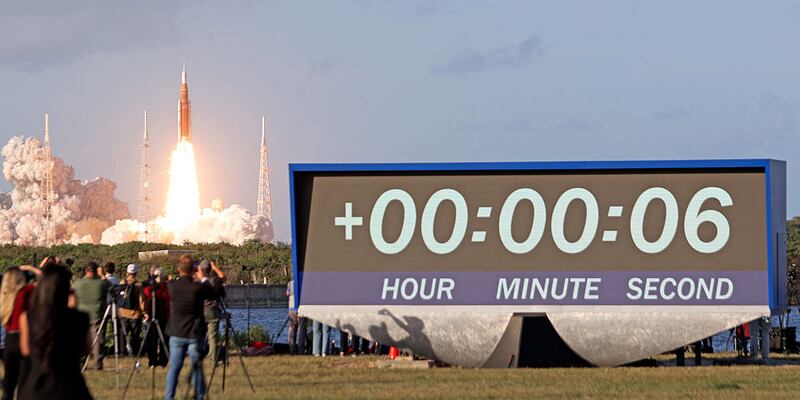
CAPE CANAVERAL — Four astronauts rocketed into space on Wednesday on the first mission to the moon in more than a half-century.
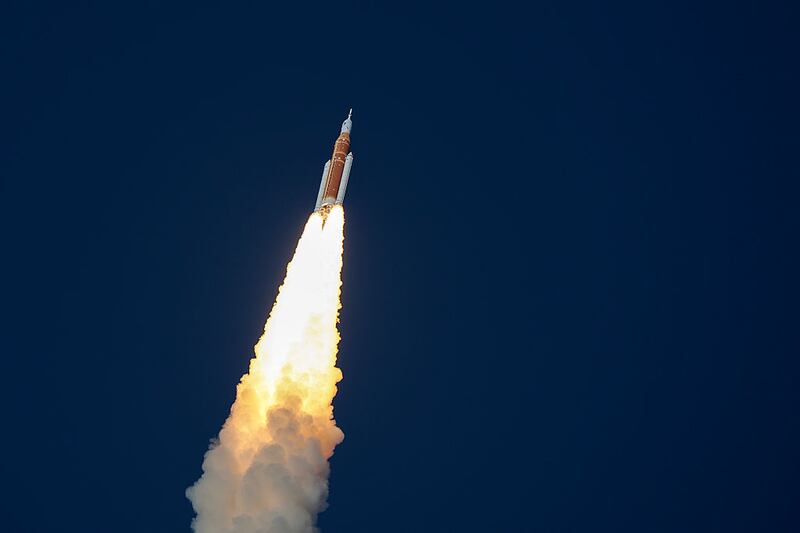
The crew of the Artemis II lifted off from pad 39B at the Kennedy Space Center in Cape Canaveral at 6:35 p.m. ET, rising into the clear Florida sky and heading eastward over the Atlantic Ocean, The New York Times reported.
The 32-story rocket will take the crew members -- NASA astronauts Reid Wiseman, Victor Glover, and Christina Koch, and Canadian Space Agency astronaut Jeremy Hansen -- on a journey around the moon.
The mission is a series of firsts for space travel. Glover is the first Black man to ride into deep space, while Koch is the first woman to do so, the Times reported. Hansen becomes the first non-American to participate in a moon mission, according to the newspaper.
The Orion spacecraft successfully separated from the upper stage of the rocket, and the "proximity operations" test is underway. The Artemis II astronauts are manually piloting Orion similarly to how they would if they were docking with another spacecraft. pic.twitter.com/RWW4RSyaoq
— NASA (@NASA) April 2, 2026
The astronauts will not land but will circle the moon, similar to the Apollo 8 mission that saw astronauts Frank Borman, James Lovell and William Anders enter the lunar orbit in December 1968.
Artemis II is the first mission to the moon since Apollo 17 landed on the lunar surface on Dec. 11, 1972, CNN reported.
“On this historic mission, you take with you the heart of this Artemis team, the daring spirit of the American people and our partners across the globe, and the hopes and dreams of a new generation,” launch director Charlie Blackwell-Thompson told the crew just before liftoff, according to The Associated Press. “Good luck, Godspeed Artemis II. Let’s go.”
On Day 2 of the space mission, the crew was scheduled to wake up at 7 a.m. ET to perform a “perigee raise burn,” CNN reported.
The task will lift the lowest point of the Orion capsule’s orbit around Earth and prepare the spacecraft for a key translunar injection burn, according to the cable news network. Then the capsule will leave the circular orbit of Earth and transition to an oval-shaped trajectory that will send it to the moon.
Crew members will go back to sleep at around 9:40 a.m. ET and will wake up four hours later.
Check out the first pictures of the #Artemis II launch from our remote cameras. Keep checking back for more! 📷 https://t.co/0AEy2WWeQo pic.twitter.com/gOTItZnucJ
— NASA HQ PHOTO (@nasahqphoto) April 2, 2026
The spacecraft separated from the upper stage of the rocket and Glover manually flew it, the Times reported. He nudged it close to the discarded rocket stage, a maneuver that will be used in later missions for docking with lunar landers, according to the newspaper.
According to NASA, the 10-day mission will help test the systems and hardware necessary for sending astronauts to future missions to explore the moon, and eventually send a crew to Mars for the first time.
The capsule is expected to reach the moon on Monday, the Times reported. It will swing around the far side of the lunar surface and will set a distance record for NASA.
The ship will travel approximately 252,799 miles from Earth -- 4,144 miles farther than the Apollo 13 crew that had to make an emergency return, according to the newspaper.
0 of 19





© 2025 Cox Media Group